How to Keep Accurate Supervision Logs: A Guide for Texas LMSWs
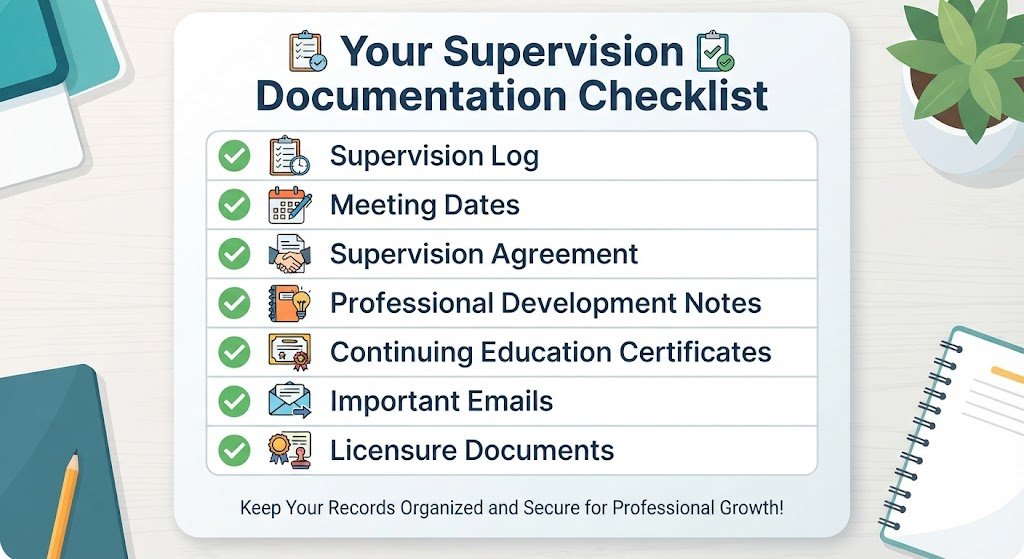
If you're an LMSW working toward LCSW licensure in Texas, clinical supervision is an important part of your professional development. It gives you time to discuss clinical cases, strengthen your reasoning, receive feedback, and work through questions that come up in practice.
It also comes with documentation responsibilities.
Keeping accurate supervision records throughout the process can make it easier to track your progress, review your supervision history, and prepare the documentation you'll need when you apply for LCSW licensure. Waiting until the end of supervision to reconstruct months or years of information can create unnecessary problems.
A simple documentation routine can help you stay organized from your first supervision session through the completion of your supervised clinical experience.
Why Accurate Supervision Records Matter
It's easy to think of supervision documentation as paperwork you'll deal with later. It's more useful to treat it as part of your supervision process from the beginning.
BHEC's current rules require supervision notes to be legible, accurate, and complete, and to document the content, duration, and date of each supervision session. Texas also requires documentation related to supervised clinical experience when you apply for LCSW licensure.
Keeping your own organized records can help you:
Track supervision sessions over time
Monitor your progress toward your clinical experience requirements
Keep important forms and records together
Review topics and questions discussed during supervision
Identify gaps or inconsistencies while they can still be addressed
Prepare for future licensure paperwork
Your personal log shouldn't replace required BHEC forms or your supervisor's official records. Instead, it can serve as an organized way to keep track of your own supervision experience.
What Should You Record After Each Supervision Session?
BHEC's rules specify that supervision documentation should include the content, duration, and date of each session. Your own tracking system can contain additional information that helps you remember what you worked on and what you want to revisit.
Depending on your system, you might record:
Date of supervision
Duration of the session
Individual or group supervision
General clinical topics discussed
Clinical questions you brought to supervision
Assessment or treatment-planning topics
Ethical or professional issues discussed
Feedback you received
Follow-up questions or action items
Keep your notes focused on the supervision experience rather than creating a detailed clinical record of your clients.
You don't need to recreate the entire conversation after every session. A concise, accurate record is usually more useful than a lengthy note that includes unnecessary information.
Update Your Log Consistently
One of the easiest ways to avoid documentation problems is to update your records shortly after each supervision session.
You might take a few minutes to:
Record the date and duration.
Identify whether the session was individual or group supervision.
Note the general content discussed.
Record questions or follow-up items.
Save any related documentation in the appropriate location.
Check that your running records remain consistent with your supervision schedule.
The exact system you use matters less than whether you can maintain it accurately over time.
Trying to reconstruct months of supervision from memory is much harder than keeping up with your records as you go.
Keep Your Records Organized
Your supervision documentation may include more than a session log.
Depending on your circumstances, you may also need to keep track of items such as:
Clinical Supervision Plan
Clinical Supervision Verification Forms
Supervision records
Supervisor information
Employment or clinical experience information
Copies of relevant correspondence
Licensure-related documents
BHEC provides specific forms and instructions for documenting supervised experience. Your personal records should complement those requirements rather than replace them.
A simple folder structure can make your records easier to find.
For example:
LCSW Supervision
Supervision Logs
Supervision Plan
Verification Forms
Supervisor Records
Clinical Experience
Licensure Documents
If you use digital storage, make sure the system you choose is secure and appropriate for the information you're keeping.
Protect Client Confidentiality
Clinical supervision involves discussing real clinical situations, but your personal supervision log shouldn't become a second client chart.
Avoid including unnecessary identifying information such as:
Client names
Dates of birth
Addresses
Phone numbers
Medical record numbers
Other information that could identify a specific client
Instead, describe the clinical topic in general terms.
For example:
Instead of:
Discussed treatment planning for Jane Smith, DOB 03/14/1994.
Use something more general:
Discussed treatment planning for an adult client experiencing depressive symptoms.
Your supervisor may need appropriate clinical information to provide effective supervision. Your personal tracking log doesn't need to contain every identifying detail discussed during the session.
When in doubt, follow your employer's policies, your supervisor's guidance, and applicable privacy requirements.
Common Supervision Documentation Mistakes
Even organized supervisees can run into documentation problems. Most are easier to address when they're identified early.
Mistake #1: Waiting Until the End to Organize Your Records
It's tempting to assume you'll organize everything when you're closer to completing your clinical hours.
That can make small inconsistencies much harder to resolve.
Better approach: Keep your records current throughout supervision.
Mistake #2: Tracking Only the Date
A calendar showing that supervision occurred doesn't necessarily tell you what was discussed.
BHEC's rules require supervision documentation to include the content, duration, and date of each session.
Better approach: Track the required information and use your own notes to record the general focus of the session.
Mistake #3: Including Too Much Client Information
Your supervision log shouldn't contain unnecessary identifying information about clients.
Better approach: Use broad clinical descriptions and follow applicable confidentiality requirements.
Mistake #4: Keeping Everything in Different Places
When some records are in email, others are on your computer, and additional information is handwritten in a notebook, it becomes harder to determine what is current.
Better approach: Choose one primary system for organizing your supervision documentation.
Mistake #5: Assuming Your Personal Log Is the Official Record
Your personal tracking system is useful, but it doesn't replace documentation required by BHEC or records maintained by your supervisor.
Better approach: Know which documents are official, keep copies of records you're entitled to receive, and ask your supervisor or BHEC when you're unsure about a requirement.
What If You Change Supervisors?
Changing supervisors can make organization even more important.
BHEC's current guidance addresses documentation for supervised experience from multiple supervisors, including the submission of separate Clinical Supervision Verification Forms when applicable. BHEC also states that an LMSW may have more than one LCSW supervisor simultaneously.
If your supervision arrangement changes, keep track of:
Previous supervisor information
Dates of supervision
Supervision records
Clinical Supervision Verification Forms
Your Clinical Supervision Plan
Clinical experience associated with each supervisor
Any relevant communication about the change
Don't assume that changing supervisors means your previous experience automatically starts over, but don't assume that every hour will automatically be accepted either. Keep the documentation needed to verify your experience and review current BHEC requirements.
For more information, read Can You Change LCSW Supervisors in Texas?
What If Your Job Changes?
Your clinical role can change while you're completing your supervised experience.
You might:
Change employers
Take on a different position
Add or lose clinical responsibilities
Reduce your clinical hours
Move from one setting to another
When your work changes, review your supervision arrangement and documentation rather than assuming the change has no effect on your licensure timeline.
BHEC's current requirements distinguish supervised professional clinical experience from simply holding a particular job title. Keeping accurate records of your clinical work can help you and your supervisor monitor your progress.
For a deeper explanation, see What Counts as Clinical Experience for LCSW Licensure in Texas?
Paper or Digital: Which Should You Use?
There's no single format that every LMSW has to use for their personal tracking system.
Paper Records
A paper system may work well if you prefer handwritten notes.
Potential advantages:
Simple to use
Doesn't require software
Easy to update immediately after a session
Potential challenges:
Can be misplaced
More difficult to search
Requires additional steps to create backups
Digital Records
Digital systems can make it easier to organize and search your information.
Potential advantages:
Easy to update
Searchable
Simple to organize
Easier to maintain backups
Potential challenges:
Requires appropriate security
Files can become disorganized if naming conventions aren't consistent
Access may become an issue if files are stored on a work device
The best system is the one you can maintain accurately and securely throughout your supervision experience.
Use Your Records to Support Your Professional Development
Supervision documentation can also help you reflect on how your clinical skills are developing.
Over time, you may notice changes in areas such as:
Clinical reasoning
Assessment
Treatment planning
Documentation
Ethical decision-making
Professional judgment
Confidence discussing difficult cases
Your log doesn't need to become a detailed journal. Even brief notes about recurring learning themes can help you see what you're working on and what you may want to discuss next.
How Clinical Supervision Supports Professional Development
Accurate documentation is only one part of a strong supervision experience.
Clinical supervision also gives you space to:
Discuss challenging cases
Examine your clinical reasoning
Review assessment and treatment planning
Work through ethical questions
Receive feedback
Develop professional judgment
Prepare for the next stages of your licensure journey
A good supervision process should address both your required experience and your development as a clinician.
For more information about what supervision can look like, read What to Expect During Clinical Supervision.
Frequently Asked Questions About Supervision Logs
How often should I update my supervision log?
It's a good practice to update your personal log shortly after each supervision session while the information is still fresh.
More importantly, your records should remain accurate and consistent with the supervision that actually occurred.
What information should I include?
BHEC's current rules require supervision documentation to record the content, duration, and date of each supervision session. Your personal log can also include whether the session was individual or group supervision, general learning topics, questions, and follow-up items.
Should I keep digital or paper records?
Either can work for your personal tracking system. Choose a format that you can maintain consistently and store securely.
Should I include client names in my supervision log?
No. Avoid unnecessary identifying client information in your personal supervision records.
Use general clinical descriptions instead and follow your employer's policies, your supervisor's guidance, and applicable confidentiality requirements.
Is my personal supervision log enough for BHEC?
Not necessarily.
Your personal log is a tracking tool. It doesn't replace BHEC forms, your Clinical Supervision Plan, Clinical Supervision Verification Forms, or other documentation required for licensure. Review current BHEC requirements when preparing your application.
Can my supervisor help me stay organized?
Your supervisor can help you understand the supervision process, review your progress, and identify documentation questions. It's still important to maintain your own records and understand the requirements that apply to your licensure path.
Clinical Supervision for Texas LMSWs
Brittany Woodley, LCSW-S, provides virtual clinical supervision for Texas LMSWs working toward LCSW licensure.
Current Availability
Current Clinical Supervision Groups
Wednesday Clinical Supervision Group
Wednesdays | 4:00–6:00 PM
Virtual | Texas LMSWs
Limited spots remain
Tuesday Evening Group
Tuesdays | 6:00–8:00 PM
Virtual | Texas LMSWs
Currently full
Official Texas Resources
Because BHEC requirements can change, use current Board resources when confirming licensure and supervision requirements.
Important: This article is for general educational purposes and isn't a substitute for reviewing current BHEC rules, forms, or instructions. Requirements can change, so confirm current requirements directly with BHEC before submitting licensure documentation.