
What to Expect During Clinical Supervision: A Complete Guide for Texas LMSWs
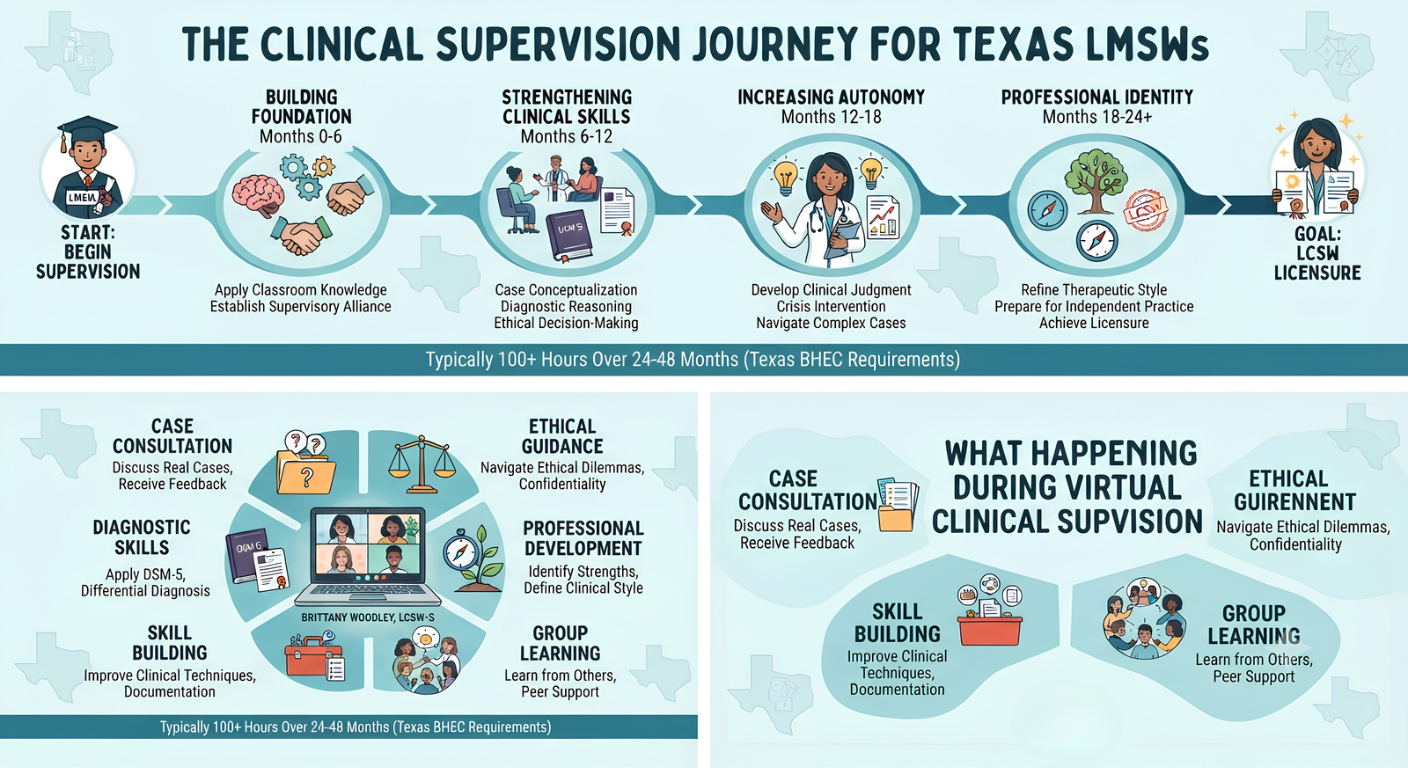
Starting clinical supervision is an important step for Texas LMSWs working toward LCSW licensure.
You may already know that supervision is part of the licensure process, but you may still be wondering what actually happens once you begin.
You might be asking:
What happens during a supervision session?
Will I have to present cases?
What if I don't know the answer to a clinical question?
What kinds of topics will we discuss?
How does group supervision work?
How can supervision help me become a stronger clinician?
Clinical supervision is more than checking off required hours. It gives you a structured place to discuss your clinical work, ask questions, receive feedback, and develop your professional judgment.
The experience can vary depending on the supervisor, supervision format, and your clinical setting. Understanding what to expect can help you enter supervision prepared and make the most of the experience.
What Is Clinical Supervision?
Clinical supervision provides ongoing professional guidance as you develop your clinical social work skills.
For Texas LMSWs pursuing LCSW licensure, BHEC currently requires at least 3,000 hours of supervised professional clinical experience, at least 100 hours of supervisory sessions, and a minimum supervision period of 24 full months. Supervision must occur in proportion to the actual hours worked, and no more than 10 hours of supervision can be counted in one month or 30-day period toward the minimum requirements.
Those requirements describe what must be completed for licensure. Your supervision experience itself should also give you opportunities to develop your clinical reasoning, professional judgment, and confidence.
What Happens During a Clinical Supervision Session?
There isn't one standard format for every supervision session.
Your supervisor may structure sessions around case consultation, clinical questions, professional development, documentation, ethics, treatment planning, or other issues that come up in your work.
A session may include:
Reviewing current clinical cases
Discussing assessment and treatment planning
Exploring clinical questions
Reviewing documentation concerns
Discussing ethical situations
Exploring client engagement and treatment barriers
Talking through professional challenges
Preparing for upcoming clinical situations
Reviewing your progress toward licensure
The goal isn't simply to tell you what to do. Good supervision creates space for you to explain your thinking, consider different perspectives, and strengthen your ability to make sound clinical decisions.
Case Consultation Is a Major Part of Supervision
Case consultation gives you an opportunity to bring questions from your actual clinical work into supervision.
You may discuss situations involving:
Assessment
Diagnosis
Treatment planning
Risk assessment
Crisis situations
Client engagement
Documentation
Boundaries
Ethical concerns
Difficult treatment decisions
You don't need to have everything figured out before bringing a case to supervision.
In fact, uncertainty is often where supervision can be most useful.
Your supervisor can help you examine the situation, identify relevant clinical and ethical considerations, and think through possible approaches.
Over time, this process can help you become more comfortable explaining and defending your clinical reasoning.
You May Discuss Diagnosis and Clinical Assessment
Diagnosis can feel challenging when you're beginning to apply what you learned in graduate school to real clients.
Supervision can give you an opportunity to work through diagnostic questions and consider how assessment information connects with treatment.
Depending on your clinical work, discussions may include:
Presenting symptoms
Differential diagnosis
Relevant history
Functional impairment
Risk factors
Protective factors
Treatment goals
Diagnostic documentation
Changes in presentation over time
The goal isn't simply to memorize diagnostic criteria. It's to develop a thoughtful process for understanding the client and making appropriate clinical decisions.
You'll Develop Your Clinical Reasoning
One of the biggest changes after graduate school is learning how to move from knowing information to applying it.
You may find yourself asking:
"Is this intervention appropriate?"
"What should I consider before changing the treatment plan?"
"How should I respond to this client's presentation?"
"What am I missing?"
Supervision gives you a place to work through these questions.
Rather than providing an answer to every situation, a supervisor may ask questions that help you examine your reasoning, consider alternatives, and identify factors you may not have considered.
That process can help you become more independent in your clinical thinking.
Ethics and Professional Judgment Are Part of Supervision
Clinical work often involves situations that don't have an obvious answer.
Supervision can provide a place to discuss ethical and professional questions before you make a decision.
Topics may include:
Confidentiality
Informed consent
Professional boundaries
Mandated reporting
Documentation
Dual relationships
Cultural considerations
Client safety
Scope of practice
Professional communication
These conversations can help you understand not only what a rule says, but how professional judgment applies in real situations.
You'll Receive Feedback on Your Clinical Work
Supervision should include opportunities to receive constructive feedback.
Feedback may involve:
Clinical reasoning
Assessment
Treatment planning
Documentation
Communication
Professional boundaries
Areas for continued development
Receiving feedback can feel uncomfortable at first, especially if you're still building confidence as a clinician.
You don't need to approach supervision as though you're expected to be perfect.
The purpose is to learn, reflect, and continue developing.
Group Supervision Gives You Another Perspective
Group supervision allows multiple supervisees to learn within the same supervision setting.
BHEC rules allow supervision toward licensure to occur individually, in groups, or through a combination of individual and group supervision. Texas rules currently provide for supervision groups of two to six supervisees.
One benefit of group supervision is that you're exposed to questions and situations that may be different from your own clinical work.
One supervisee may bring a question about documentation.
Another may be working through a treatment-planning concern.
Someone else may raise an ethical question that you haven't encountered yet.
Listening to these discussions can expand your clinical perspective and help you think through situations you may encounter later in your career.
Group supervision also gives you the opportunity to learn from other LMSWs while receiving guidance from the supervisor.
You Don't Need to Know Everything Before You Start
It's common for new clinicians to worry that they should already have all the answers.
You don't.
Clinical supervision is a place for professional learning.
If you're unsure about a diagnosis, treatment approach, documentation question, or difficult client interaction, bringing that question to supervision can be more useful than trying to figure it out alone.
Questions can also help your supervisor understand where you need additional support.
The more openly you participate, the more useful the supervision relationship can become.
Supervision Can Help You Connect Theory With Practice
Graduate education gives you a foundation.
Clinical work requires you to apply that foundation to individual clients and real-world situations.
Supervision can help connect the two.
You may discuss how concepts such as:
Trauma
Attachment
Cognitive and behavioral approaches
Crisis intervention
Family systems
Client strengths
Cultural considerations
Risk and safety
apply to the clients you're actually serving.
This is where supervision can become more than a licensure requirement. It becomes part of your ongoing clinical development.
You'll Also Work on Professional Development
Clinical supervision isn't limited to individual cases.
As you gain experience, you may also discuss your professional goals and the kind of clinician you want to become.
Topics may include:
Identifying clinical strengths
Areas for continued growth
Professional boundaries
Communication
Career goals
Leadership
Areas of clinical interest
Developing your professional identity
Preparing for independent practice
Your supervision experience should give you opportunities to develop your own clinical style while remaining grounded in professional ethics and standards.
What About the ASWB Clinical Exam?
The ASWB Clinical Exam is a separate part of the LCSW licensure process.
BHEC currently lists passage of the ASWB Clinical examination among the requirements for Texas LCSW licensure.
Clinical supervision and exam preparation aren't the same thing, but the clinical reasoning you develop during supervision can support your broader preparation for professional practice.
If your supervisor offers exam preparation, ask what is included and when that preparation is incorporated into the supervision process.
How Does Virtual Clinical Supervision Work?
BHEC rules allow supervision to take place through web technology or other electronic methods when the applicable requirements for confidentiality, HIPAA, and Texas law are met. The supervision plan must describe the supervision methods and how they support the supervisee's professional development and confidentiality.
For a virtual supervision program, you should expect the same level of preparation and participation that would be expected in any other professional supervision setting.
Before starting, ask your supervisor:
What platform do you use?
How are confidential case discussions handled?
How are supervision sessions documented?
How often will we meet?
How will my supervision progress be tracked?
What happens if I need to reschedule?
How will individual concerns be addressed within a group setting?
These questions can help you understand how the program works before you commit.
What Should You Bring to Supervision?
You don't need to arrive with a perfectly prepared presentation every time.
It can help to come prepared with:
A clinical question
A challenging case
A treatment-planning concern
A documentation question
An ethical situation
A professional development goal
Something you want feedback on
Questions about your progress toward licensure
Keeping brief notes between sessions can also help you remember questions that come up during your clinical work.
How Can You Get the Most From Supervision?
Your supervisor provides guidance, but your participation matters too.
You can make supervision more useful by:
Come Prepared
Bring questions, cases, concerns, and situations you'd like to discuss.
Be Open to Feedback
Feedback is part of professional development. Try to approach it as an opportunity to examine your work rather than as a judgment of you as a clinician.
Ask Questions
If you don't understand something, ask.
Track Your Progress
Keep up with your supervision hours, clinical experience, documentation, and other licensure requirements.
Speak Up About Your Goals
Let your supervisor know what you want to strengthen clinically and professionally.
Take What You Learn Into Practice
The value of supervision doesn't end when the session ends. Apply what you discuss to your clinical work and return with questions about what happened.
What If You're Changing Supervisors?
Changing supervisors can happen for different reasons, including a change in employment, scheduling issues, relocation, or a difference in supervision needs.
If you're considering a change, review your current supervision records and discuss your situation with your prospective supervisor before making the transition.
BHEC maintains clinical supervision forms, including the Clinical Supervision Plan and Clinical Supervision Verification Form for LCSW applicants.
You can also request a copy of your supervision file from your supervisor. BHEC's current FAQ states that supervisors should maintain accurate records and provide copies when requested.
Frequently Asked Questions
What happens during clinical supervision?
Sessions can include case consultation, clinical reasoning, treatment planning, ethics, documentation, professional development, and questions related to your clinical work.
Will I have to present cases?
Case discussion is a common part of clinical supervision, particularly when supervision involves clinical case consultation. Your supervisor should explain how cases are presented and discussed within the supervision format.
What if I don't know the answer to a clinical question?
That's one of the reasons supervision exists. Bring the question to your supervisor and use the discussion to explore the clinical, ethical, and professional considerations involved.
Can clinical supervision be completed virtually?
BHEC allows supervision through web technology and other electronic methods when applicable requirements for confidentiality and applicable laws are met. Your supervision plan should describe the methods being used.
Can supervision be completed in a group?
Yes. BHEC permits supervision toward licensure to occur individually, in groups, or through a combination of individual and group supervision. Current Texas rules limit supervision groups to two through six supervisees.
How many supervision hours do I need for the Texas LCSW?
BHEC currently requires at least 100 hours of supervisory sessions completed over the course of at least 3,000 hours of supervised professional clinical experience and a minimum period of 24 full months.
What should I look for in a clinical supervisor?
Consider the supervisor's current credentials, clinical and supervision experience, supervision style, availability, format, documentation practices, and whether their approach fits your professional development goals.
Ready to Begin Clinical Supervision?
If you're a Texas LMSW working toward your LCSW, understanding what supervision involves can help you approach the process with greater clarity.
Brittany A. Woodley, LCSW-S, LISW-S, provides virtual clinical supervision for eligible LMSWs throughout Texas.
Current Availability
Current Clinical Supervision Groups
Wednesday Clinical Supervision Group
Wednesdays | 4:00–6:00 PM
Virtual | Texas LMSWs
Limited spots remain
Tuesday Evening Group
Tuesdays | 6:00–8:00 PM
Virtual | Texas LMSWs
Currently full
Supervision requirements and regulations can change. Review current BHEC requirements and discuss your individual circumstances with your supervisor before making decisions about your licensure plan.